Brain 101 for Kids · Lesson 1
What is your brain?
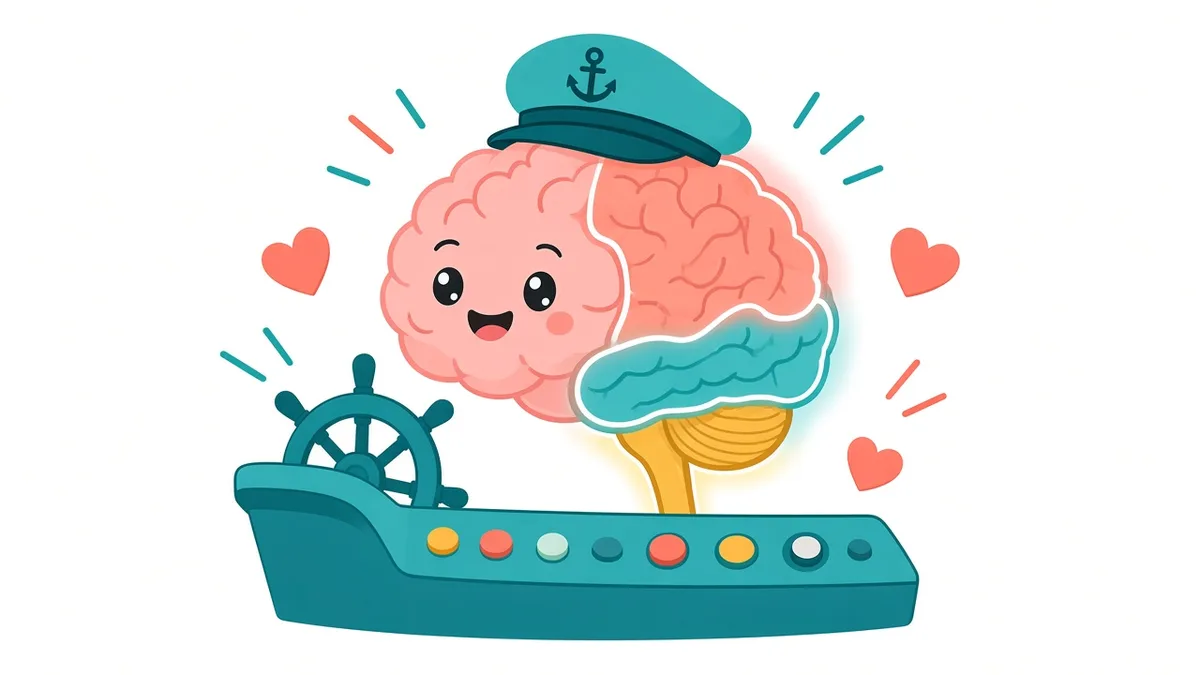
Your brain is the boss of your body. It helps you think, move, feel and remember. It even keeps you breathing while you sleep! Let's meet its three big parts.
Your body's control center
Your brain lives inside your head, safe inside your skull. It is soft, a bit like firm jelly, and wrinkly on the outside. It sends messages to every part of your body, and gets messages back, through long threads called nerves. The main cable is the spinal cord, a thick bundle of nerves that runs down inside your backbone.
A grown-up's brain weighs about 1.4 kilograms (about 3 pounds). That is only about 2 out of every 100 parts of your body weight, but your brain uses about one fifth of your body's energy, even when you are resting!
By about age 6, your brain is already around 90% of its grown-up size. But it keeps learning and changing your whole life.
Meet the three big parts
Tap Tap a part of the brain
👆 Tap a colored part or a button to meet it.
Cerebrum (say: suh-REE-brum)
The biggest part, and the thinking part. Here you learn, talk, imagine, see, hear and feel touch. It has two halves. Fun twist: the left half mostly controls the right side of your body, and the right half mostly controls the left side!
Cerebellum (say: sair-uh-BELL-um)
The balance part, tucked at the back. It makes your moves smooth when you ride a bike, catch a ball or dance. It is small, but it holds most of the brain's nerve cells: about 4 out of every 5!
Brainstem
The autopilot part. It joins the brain to the spinal cord and runs jobs you never have to think about: breathing, your heartbeat, swallowing, and helping you fall asleep and wake up. It works day and night.
How is your brain protected?
Your brain is precious, so your body guards it in three ways:
- The skull: a hard shell of bone, like a built-in helmet.
- The meninges (say: muh-NIN-jeez): three thin layers that wrap around the brain like cozy blankets.
- Cerebrospinal fluid: a clear liquid that cushions the brain so it can float and not bump the skull.
Try it! Stand on one foot next to a wall or chair, then close your eyes. A bit wobbly? That is your cerebellum working hard to keep you balanced!
Neuroscientist: a scientist who studies the brain and nerves. Maybe you will be one someday!
Quiz 3 quick questions
1. Which part helps you balance on a bike?
2. Which part keeps you breathing while you sleep?
3. The left half of your cerebrum mostly controls…