Brain 101 for Kids · Lesson 2
Neurons: the brain's messengers
Your brain is made of tiny cells called neurons (say: NOOR-ons). They are the brain's messengers, passing signals to each other faster than a race car!
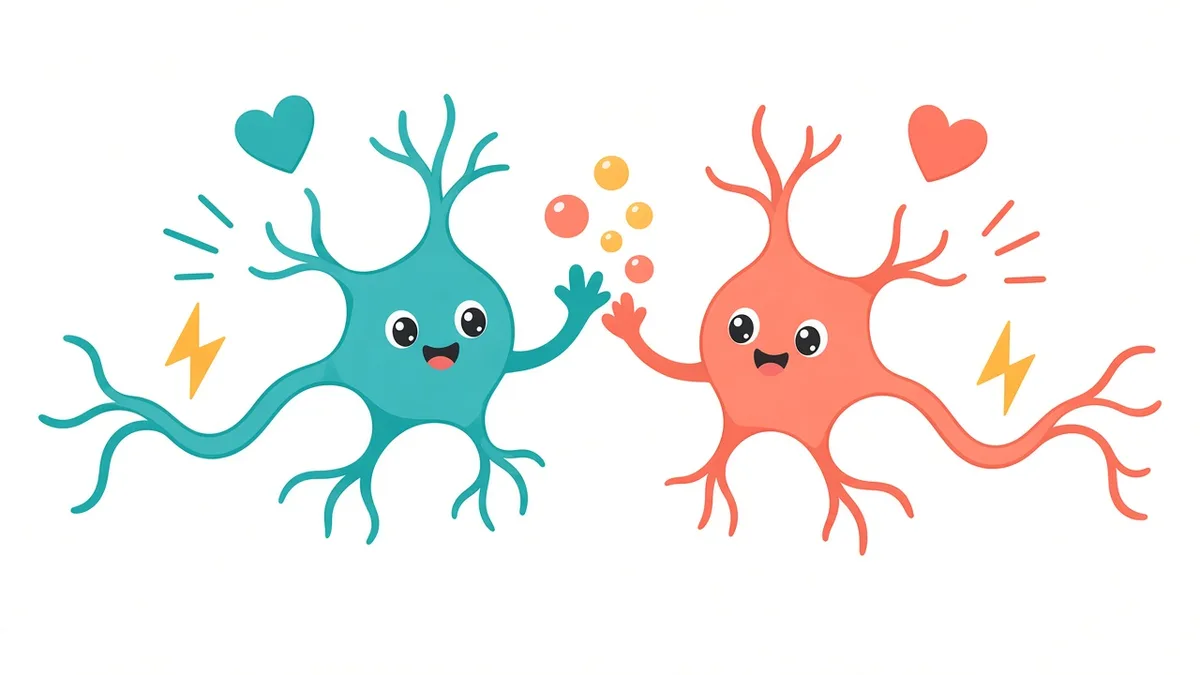
Meet a neuron
Your brain has about 86 billion neurons. If you counted one every second, without stopping to sleep, it would take you more than 2,000 years! Each neuron has a few important parts:
Dendrites: branches that catch messages from other neurons, like a tree catching raindrops.
Cell body: the neuron's home base. It decides whether to pass the message on.
Axon: a long cable that carries the message away.
Myelin (say: MY-uh-lin): a fatty coating on many axons, like the plastic on a wire. It makes signals zoom faster.
Synapse (say: SIN-aps): the tiny gap between one neuron and the next.
How a message travels
- A tiny electrical signal zooms down the axon.
- At the end, it reaches the synapse. The gap is so small that thousands of them would fit across the width of one hair!
- The neuron lets out chemical messengers called neurotransmitters. They float across the gap.
- The next neuron catches them and sends its own signal. Pass it on!
Play Send a signal
Press the button to send a message from one neuron to the next. Then turn myelin off and compare!
The fastest signals travel up to about 120 meters per second. That is more than 400 kilometers (about 270 miles) an hour!
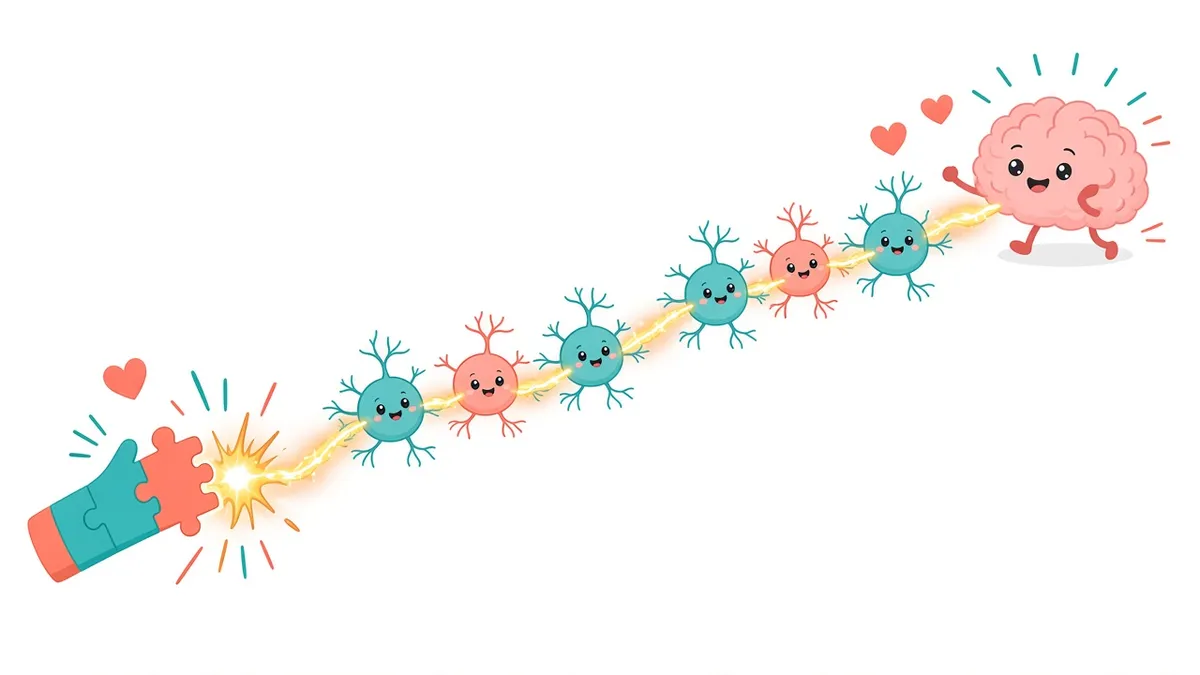
Why this website is called Little Synapses
Every time you practice something, like reading, riding a scooter or playing piano, the synapses you use get stronger, and new connections can grow. It is like walking across a grassy field: the more you walk the same way, the clearer the path becomes. Your brain is full of little synapses doing big things. That is why this website is called Little Synapses!
Your brain also has helper cells called glia (say: GLEE-uh). There are about as many glia as neurons. They feed, protect and clean up after the neurons.
Try it! Learn something tricky, like a new word or a juggling move, and practice it for a few minutes each day this week. Notice how it gets easier. That is your synapses getting stronger!
Quiz 3 quick questions
1. What is the tiny gap between two neurons called?
2. What does myelin do?
3. What makes your synapses stronger?