Epilepsy · For clinicians
Lennox-Gastaut Syndrome: Comparing the US and European Treatment Approaches
Two recent expert papers, one from Europe and one from the United States, offer contrasting but complementary views on managing Lennox-Gastaut syndrome (LGS). Here is how they compare.
This piece is adapted from my thread on the two papers. [view on X]
What is LGS?
LGS is a severe, childhood-onset developmental and epileptic encephalopathy (DEE). It is marked by multiple drug-resistant seizure types, specific EEG patterns and significant cognitive and behavioral impairment. Early diagnosis can be difficult. [view on X]
Diagnosis requires multiple types of drug-resistant seizures (including tonic seizures), cognitive and often behavioral impairment, and specific EEG findings: diffuse slow spike-and-wave and generalized paroxysmal fast activity. [view on X]
The European approach
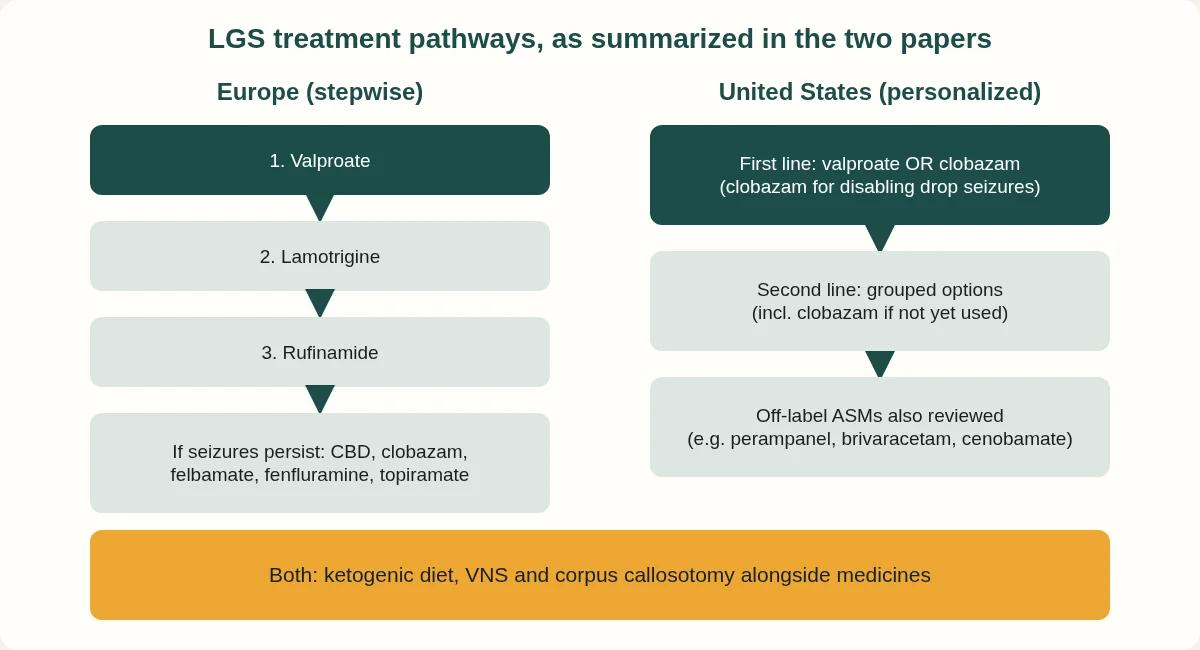
The European algorithm is stepwise: valproate first, then lamotrigine, then rufinamide. If seizures persist, it suggests considering cannabidiol (CBD), clobazam, felbamate, fenfluramine (FFA) and topiramate. The focus is on licensed medicines and practical guidance. [view on X]
The European paper gives particular attention to the newer anti-seizure medications (ASMs), cannabidiol and fenfluramine, including licensing (in Europe, CBD is licensed with clobazam), efficacy and side effects. [view on X]
The US approach
The US expert panel emphasizes a personalized approach, starting with either valproate or clobazam as first-line therapy, especially for disabling drop seizures. [view on X]
The US paper looks closely at meta-analyses in LGS and notes conflicting results due to varying study designs, which underscores the need for personalized treatment and careful evaluation of the evidence. [view on X]
It also reviews off-label ASMs such as perampanel, brivaracetam and cenobamate alongside the eight FDA-approved drugs, widening the options for difficult cases. [view on X]
Key differences
The biggest difference concerns clobazam. The US paper suggests it can be a first-line therapy, particularly for disabling drop seizures, and notes the synergistic effects of clobazam and cannabidiol. The European paper treats it as a later adjunctive therapy. [view on X]
The American algorithm is consensus-based, with valproate or clobazam as first-line options and clobazam a strong consideration for disabling drop seizures. Second-line options are grouped together, including clobazam if it has not already been used. [view on X]
Where they agree
Both papers stress non-drug approaches, including the ketogenic diet, vagus nerve stimulation (VNS) and corpus callosotomy, used alongside ASM therapy. The American algorithm also notes that felbamate is used only after careful consideration. [view on X]
Let's discuss
What do you think of these two approaches? I'd love to hear from fellow clinicians and families. [view on X]
Links to both papers (US and European) are in the original thread. [view on X]
This is general information, not medical advice. Please talk with your child's doctor about their care.
Want more clear, evidence-first breakdowns on pediatric neurology and epilepsy?