AI in neurology
When Your EEG Monitor Talks Back: AI in Epilepsy Care
Imagine your EEG monitor texting you: “Possible seizure at 3:12 AM. Did you feel anything?” And when you answer, it gets smarter. That's no longer science fiction. A new Nature Medicine study showed it in people with epilepsy. Here is my breakdown as an epileptologist.
This piece is adapted from my thread on the study. [view on X]
The setup
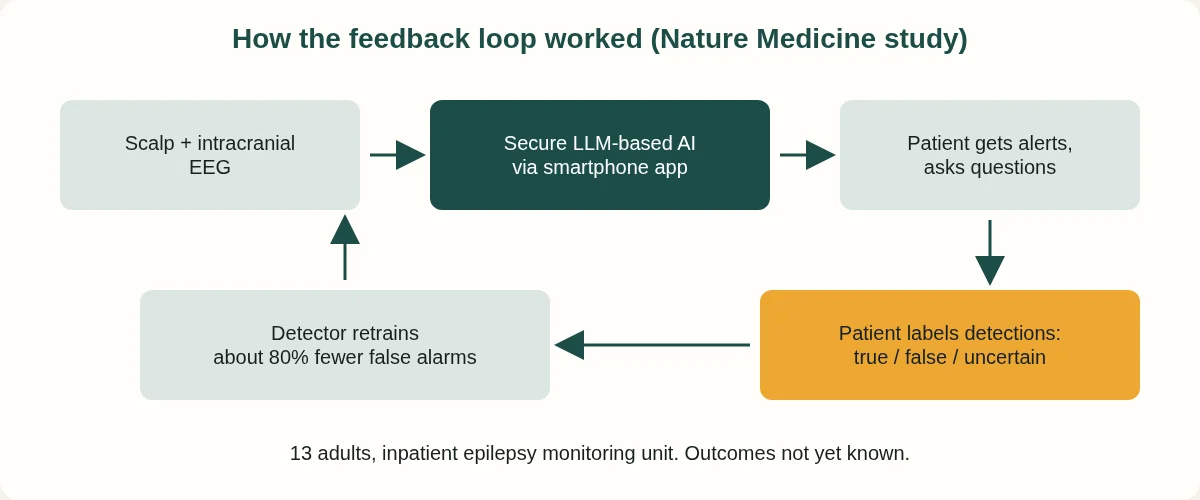
A team at Penn linked scalp and intracranial EEG to a secure AI assistant built on a large language model and reached through a smartphone app. Thirteen adults in an epilepsy monitoring unit could ask about their own brain data, receive alerts and log symptoms in real time. [view on X]
Patients actually used it
Engagement was real: more than 1,300 messages were exchanged. The AI gave accurate, relevant answers to over 92% of questions about patients' brain activity, such as “Did I have a seizure while I slept?” [view on X]
The part that excites me most
Patients labeled over 67% of the detections as true, false or uncertain. The detector retrained on that feedback and cut false alarms by about 80%. Expert feedback added only about 2% more. [view on X]
Why this matters
False alarms are the number one reason people stop trusting seizure detection and stop wearing their devices. A detector that learns from the person wearing it could change long-term monitoring at home. [view on X]
Caveats, because they matter
This study included only 13 patients, in an inpatient setting rather than daily life, and we don't yet know whether it improves outcomes. The team is planning outpatient studies with wearables and minimally invasive EEG. That will be the real test. [view on X]
The big picture
Medical devices are starting to talk with patients, not just at them. I'm a pediatric neurologist and epileptologist who builds AI workflows, and each week I break down the research that matters. [view on X]
This is general information, not medical advice. Please talk with your child's doctor about their care.
Want more clear, evidence-first breakdowns on pediatric neurology and epilepsy?